The Critical Role of Steel Ropes in Suspended Scaffolding
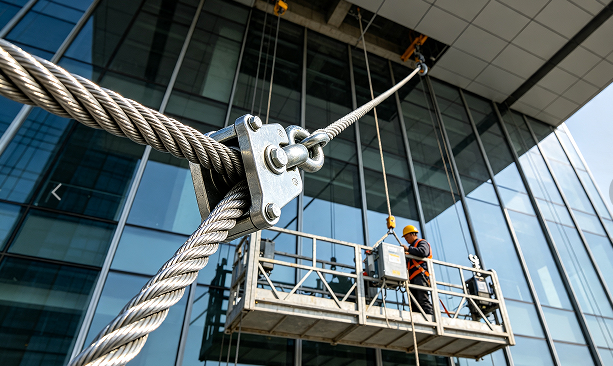
On modern construction sites, suspended scaffolding, commonly known as hanging baskets or suspended platforms, is an indispensable tool for high-rise building construction, exterior wall maintenance, and facade cleaning. While the platform and hoist mechanism often attract the most attention, it is the steel wire rope that quietly bears the entire load, supporting workers, materials, and equipment at heights that can exceed 100 meters.
Suspended scaffolding systems typically use two types of wire ropes: the working (load-bearing) rope that lifts and supports the platform, and the independent safety rope that serves as a backup in case the primary rope fails. Both ropes must meet rigorous safety and performance standards, as any failure at height can have catastrophic consequences.
Technical Specifications and Standards
Key parameters for suspended scaffolding ropes include the minimum diameter: the working rope must have a diameter of no less than 6 mm, while the independent safety rope is typically recommended to be 8 mm or larger. Many industry experts suggest that the safety rope should be at least 8 mm in diameter for enhanced reliability.
The breaking strength requirement ensures the rope can safely handle the dynamic loads encountered during lifting and lowering operations. The safety factor for suspended scaffolding ropes must be no less than 9, meaning the rope's breaking strength must be at least nine times the maximum working load, a conservative margin that accounts for wear, fatigue, and unforeseen stress events. Regarding service life, wire ropes should not be used for more than six years.
Construction and Material Choices
Suspended scaffolding ropes are typically constructed in 6x19 or 6x36 configurations, offering a balance of strength, flexibility, and abrasion resistance. Galvanized steel is the material of choice, providing corrosion protection against moisture and environmental exposure. The zinc coating helps extend rope life in outdoor construction environments where rain, dust, and temperature fluctuations are constant factors.
Fatigue and Bending Stress
One of the greatest challenges for suspended scaffolding ropes is bending fatigue. As the platform rises and lowers, the rope repeatedly bends over sheaves and drums. Each cycle causes microscopic stress on individual wires, gradually leading to wear and, eventually, wire breaks. The relationship between sheave diameter and rope diameter is critical, as larger sheaves reduce bending stress and extend rope life. Proper sheave maintenance and adequate lubrication are essential for minimizing fatigue.
Industry Trends: Smart Monitoring and Safety Integration
The suspended scaffolding market is expected to grow steadily from 2025 to 2031, driven by rising construction activities and increasing focus on renovation and maintenance. Alongside this growth, the industry is embracing several key trends.
Smart monitoring and IoT sensors represent one of the most significant trends. Sensors now provide real-time data on load distribution, platform tilt, wind speed, and, most importantly, wire rope health. This data enables proactive maintenance, instant alerts for unsafe conditions, and significant improvements in worker safety.
Lightweight and high-strength materials are also gaining attention. While steel remains dominant, innovations in aluminum alloys and composite materials are reducing platform weight without compromising strength. However, the wire ropes themselves continue to rely on high-tensile steel for the durability and fatigue resistance that suspended scaffolding demands.
Enhanced safety features, including advanced fall protection systems, self-contained braking devices, emergency descent mechanisms, and backup safety lines, are becoming standard. Comprehensive operator training on rope inspection, correct usage, and emergency response is also receiving greater emphasis.
The Human Factor: Safety Depends on Inspection
No matter how well a rope is manufactured, its safety ultimately depends on proper inspection and maintenance. Daily visual checks for broken wires, kinking, corrosion, and diameter reduction are essential. Any rope showing significant wear, such as visible broken wires within one lay length reaching a certain proportion of total wires, must be replaced immediately.
As high-rise construction continues to reshape skylines around the world, the humble steel wire rope remains the unsung hero of suspended scaffolding, bearing the load, ensuring safety, and enabling workers to reach new heights. LAFIA WIRE ROPE supplies galvanized steel ropes for suspended scaffolding applications, with custom diameters, constructions, and lengths to meet the most demanding safety standards.